

At Dynaplant, millions of plants pass through SDF Horti Software’s Visionflow system every year. Cameras are used to assess the plants for factors such as the presence of shoots, height, and width. In this way, the system helps the nursery maintain uniformity across batches and streamline the process of spacing out the plants. The core of the logistics system—from HAWE, also part of KUBO—has been in use at the nursery for eighteen years, but the cameras and associated hardware were recently upgraded.
“In principle, the camera can collect all kinds of plant data. This includes color, size, width, height, and the number of buds, as well as the growth stage a plant is in. Which data points are relevant varies depending on the crop and application,” explains Joost van Doorn of SDF.
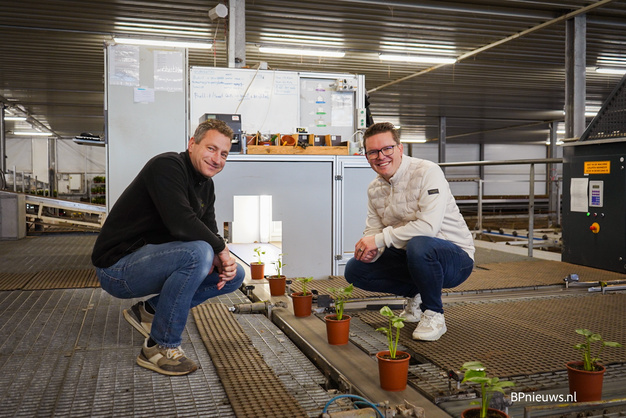
Dietrick Hanemaaijer (Dynaplant) and Joost van Doorn (SDF)
Zantedeschia
At Dynaplant, the system is used, among other things, for growing Zantedeschia and Monstera in pot sizes 12 and 13. An important part of the process is selecting plants during emergence. “When planted, a Zantedeschia corm disappears underground. After about a week or ten days, the first shoots emerge. This doesn’t happen across the entire table at once. Any plant with a visible shoot is sorted out. The plants that haven’t shown any growth yet are returned to the propagation stage,” explains Dietrick Hanemaaijer of Dynaplant.
This cycle repeats until the plants have emerged sufficiently. By selecting the plants at the right time, the resulting batches are ultimately more uniform. The camera also plays a role in a later phase. As the plants grow larger and need to be spaced further apart, the system measures their height and width. Based on these measurements, they are divided into three categories and placed at the correct distance. For example, a table can go from holding 650 pots to 250 pots.
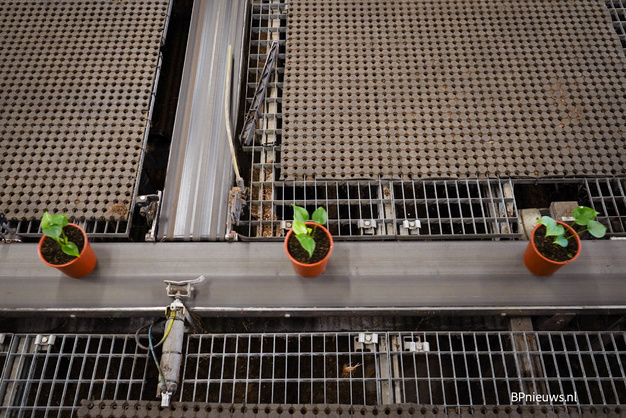
Millions of plants per year
The plants spend a relatively short time in the greenhouse. From the moment the corm is planted in the pot, the cultivation of Zantedeschia takes a maximum of thirteen weeks. In the summer, when growth is faster, this can even be reduced to ten weeks. The system can be used multiple times, depending on how evenly a batch emerges.
About 6,000 plants pass through the royal blue camera system at Dynaplant every hour. In addition, production pressure is high during the first twenty weeks of the year, Dietrick explains. “About 70 percent of our revenue is generated during that time. It is precisely during that period that an efficient cultivation and logistics process is crucial for us.”
“What we’re doing here with the Vision cameras is actually relatively simple. A camera is very good at detecting green, and when you zoom out, it measures the height and width. For example, we don’t need to count the number of buds or flowers here,” says Joost. For other crops, the system can be used in much more extensive ways, such as to determine the number of buds and to check whether a plant falls within a specific quality class.
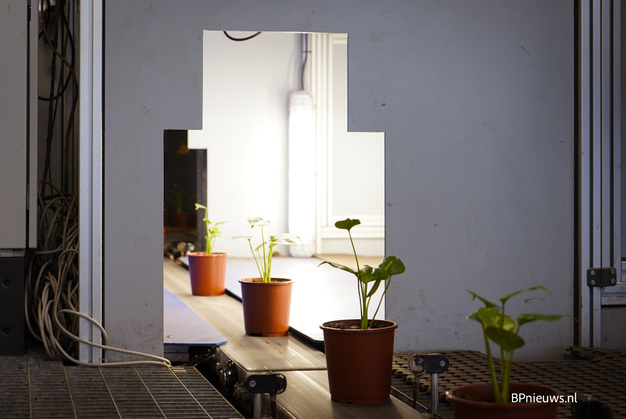
Revamped after eighteen years
Although the basic principle of the system has remained the same for eighteen years, significant investments have recently been made in modernization. The existing hardware was replaced because the software environment had become outdated. This opportunity was used to also upgrade the camera setup and lighting, which had also been in use for about eighteen years.
The upgraded cameras produce more detailed images, allowing more information to be extracted from the plants. This enables more precise adjustments at the pixel level. A five percent improvement in data quality, for example, may seem modest, but when dealing with millions of plants per year, it can make a significant difference.
For more information:
SDF Horti Software
info@sdf.nl
https://www.sdf.nl/nl
Publication date: Mon, Nov. 16, 2026


